
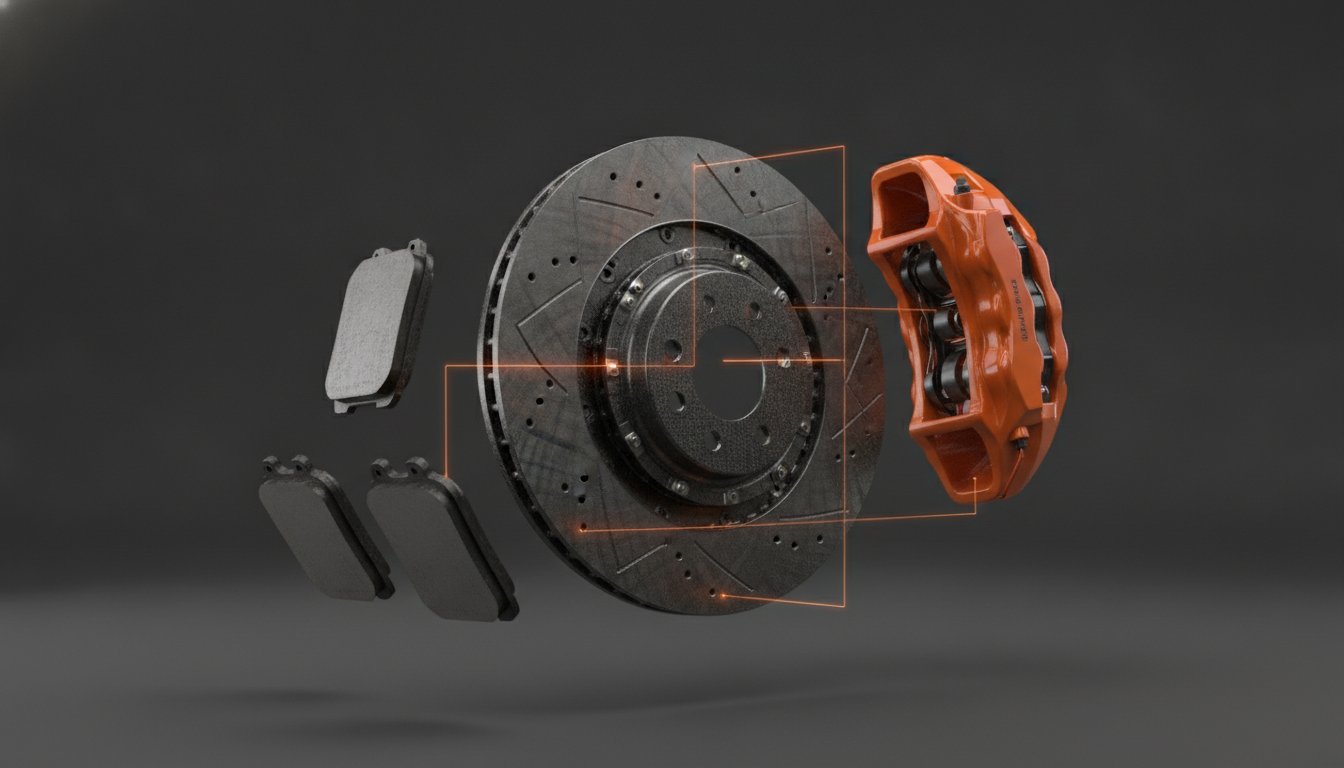
Replacing a full set of genuine carbon-ceramic rotors and pads on a modern Ferrari can cost up to $25,000 at a dealership. With the US importing $139 billion in aftermarket auto parts annually, the scale of the global supply chain is immense. Finding specific components requires an exotic car parts search engine capable of parsing fragmented global data. Professionals often struggle with inconsistent naming conventions and the challenge of verifying OEM authenticity across international borders. It's a technical bottleneck that delays repairs and inflates procurement costs.
You understand that manual dealer inquiries are inefficient for high-performance logistics. This article explains how specialized aggregators locate rare components with surgical precision. You'll learn how to leverage structured OEM data to ensure compatibility and achieve price transparency across global sellers. This guide analyzes the systematic tools required for rapid identification in a performance parts market projected to reach $442.88 billion by 2030.
Key Takeaways
- Identify the functional distinction between direct retailers and data-driven search aggregators for specialized components.
- Utilize structured OEM part numbers to bypass fragmented naming conventions and verify component authenticity across global borders.
- Deploy an exotic car parts search engine to replace manual browsing with automated, high-speed inventory indexing.
- Execute systematic sourcing protocols by integrating technical diagrams with real-time global availability data for precision procurement.
- Access high-performance retrieval tools to analyze over 300,000 structured listings for maximum price transparency and efficiency.
Defining the Modern Exotic Car Parts Search Engine
An exotic car parts search engine is a specialized digital aggregator designed for technical procurement. It doesn't maintain a physical warehouse. Instead, it functions as a data-driven bridge between global suppliers and end-users. While a direct seller is limited by its own stock, a search engine indexes hundreds of thousands of listings simultaneously. This architecture creates a transparent view of the global market, allowing users to identify price discrepancies and shipping logistics from a centralized dashboard.
General-purpose search engines like Google or Bing are insufficient for this task. They prioritize consumer-facing content over technical specifications. They often fail to index deep-web inventory databases or interpret complex part number variations. A dedicated exotic car parts search engine focuses on SKU-level precision. It filters out irrelevant marketing content to deliver raw technical data, ensuring that restorers find exact matches rather than visually similar alternatives.
Fragmented global inventory remains a primary pain point for the industry. Parts for a single Ferrari or Lamborghini model may be split between a salvage yard in the UK, a specialist in Germany, and a dealer in the US. Without a centralized aggregator, locating these items requires hours of manual outreach. These specialized tools automate the discovery phase, providing a methodical path to acquisition through structured data sets.
Aggregator vs. Retailer: Understanding the Difference
Retailers focus on inventory management and physical logistics. Search engines prioritize data architecture and stream processing. This distinction offers a significant advantage for high-volume procurement. Accessing 300,000+ listings through a single interface eliminates the need for manual dealer inquiries. Search neutrality is a core benefit. The engine presents data from multiple sellers objectively. You see the market as it exists, allowing for immediate price comparison and condition assessment. It removes the bias inherent in single-source retailers.
Utility for Restorers and Professional Shops
Professional restoration requires surgical accuracy. Search fatigue is a common bottleneck when sourcing components for legacy supercars. Specialized indexing allows shops to locate NLA (No Longer Available) parts that are invisible to standard web crawlers. Real-time availability tracking across international borders ensures that projects remain on schedule. The process often begins with the standardized 17-character identifier. This VIN data serves as the primary anchor for verifying component compatibility. By integrating this identifier into the search workflow, professionals minimize the risk of ordering incorrect specifications.
The Architecture of Supercar Component Data
Precision sourcing relies on data normalization. Raw inventory listings from global sellers are often unstructured and inconsistent. An exotic car parts search engine transforms these fragments into searchable assets by mapping them to standardized technical parameters. This process involves extracting orientation (LH/RH), condition (New, Used, Core), and fitment data from diverse sources. For high-value marques like Ferrari, McLaren, and Aston Martin, this metadata is critical. It's the only way to verify component authenticity without physical inspection.
The automotive aftermarket industry is projected to grow to $366.61 billion in 2026. Managing this volume requires a hierarchical data structure where the manufacturer part number serves as the primary key. This architectural approach ensures that a search for a McLaren 720S carbon fiber diffuser yields exact matches rather than generic alternatives. You can access these structured listings to verify current market availability and technical specifications across multiple vendors.
Part Number Precision and Cross-Referencing
Manufacturer part numbers are the only reliable identifiers in supercar logistics. They eliminate naming ambiguity. A "front wing" in the UK is a "fender" in the US; a part number remains constant. Data-driven engines handle superseded numbers within high-performance lineages. As manufacturers update components for reliability or performance, old numbers are replaced. A precision search engine indexes these legacy relationships. It ensures users find the most current revision or compatible old stock. This is vital for maintaining the mechanical integrity of limited-run vehicles where component revisions are frequent.
The Role of APIs in Automotive Logistics
Scalable sourcing requires programmatic data access. The SuperCars API allows for the direct integration of global inventory into custom workflows. Developers use this structured data to power independent inventory apps and internal procurement systems. This technology enables real-time synchronization. When a seller in Germany updates their stock, the change reflects globally within seconds. It eliminates the "ghost inventory" problem common in manual marketplaces. This provides a steady stream of verified data for professional shops and restoration centers that cannot afford the downtime associated with incorrect or unavailable parts.
Search Engines vs. Traditional Marketplaces
Traditional marketplaces rely on manual browsing. Users navigate individual dealer websites or social media platforms to find stock. This process is inherently slow. An exotic car parts search engine utilizes automated indexing to eliminate this latency. It aggregates data from European, Asian, and North American inventories into a single query. This creates immediate transparency. You can compare prices and shipping terms side-by-side without leaving the dashboard. It's the difference between a manual hunt and a systematic data retrieval.
For "halo cars" like the McLaren F1 or Ferrari Enzo, components are extremely rare. Listings for these items appear and disappear rapidly. Manual marketplaces can't maintain the refresh rates required for these high-value transactions. A specialized engine provides the speed necessary to secure parts before they're acquired by competitors. It transforms a fragmented market into a structured environment where availability is visible in real-time. This automation replaces the "concierge" model with a high-performance data stream.
Efficiency Metrics for Professional Sourcing
Professional procurement requires measurable speed. Using an aggregator provides a significant reduction in procurement cycles compared to individual dealer inquiries. You don't wait for manual responses. Instead, you see live data. Multi-source visibility lowers the risk of "out of stock" notifications. If a seller in Italy is sold out, the engine identifies an alternative in Japan or the United States. This global competition also impacts part pricing. Transparency forces sellers to remain competitive, which facilitates better price discovery for the buyer.
Data Depth: Beyond the Product Image
Unstructured marketplaces focus on visual confirmation. Social media posts show a part but lack technical context. An exotic car parts search engine prioritizes data depth. It integrates technical diagrams and fitment data directly into the search ecosystem. This allows for immediate verification of compatibility. Seller reputation is quantified through aggregated feedback loops across multiple platforms. Structured VIN verification adds a final layer of security. It ensures that a high-value transaction for a specialized component is based on verified technical data, not just a low-resolution photograph.
Strategic Sourcing: How to Utilize Advanced Search Parameters
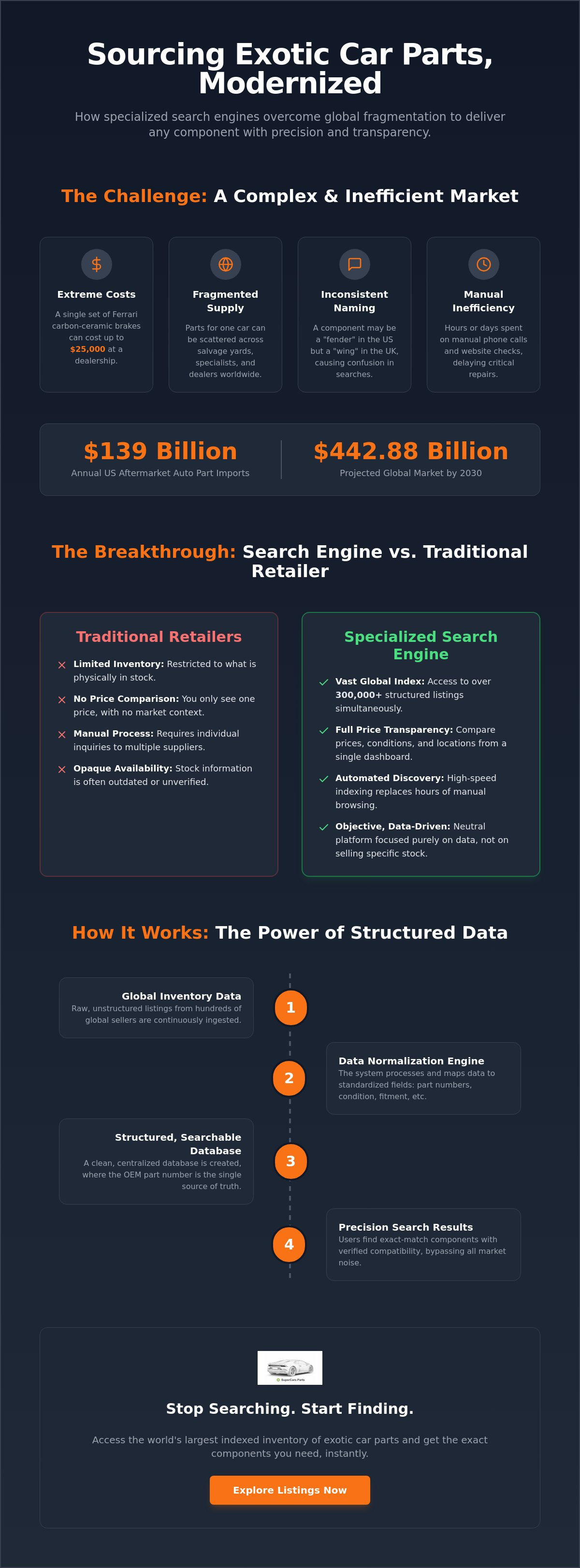
Efficient procurement of supercar components requires a five-stage technical protocol. First, identify the exact OEM part number from manufacturer-issued technical diagrams. This number is the only universal identifier across global databases. Second, deploy an exotic car parts search engine to scan indexed listings from international suppliers. Third, apply condition filters to isolate New, Used, Rebuilt, or Core units based on the specific requirements of the project. Fourth, compare the geographic location of each listing to optimize shipping logistics and minimize transit time. Finally, verify the seller's credentials and history before finalizing the transaction on their specific platform.
This methodical workflow replaces the inefficiency of manual dealer inquiries. It ensures that every procurement decision is backed by real-time market data rather than limited local availability. You can search the global inventory now to apply these advanced parameters and identify high-precision matches for complex mechanical systems.
Mastering the Search Interface
Advanced users utilize Boolean operators and exact-match strings to isolate rare components. Combining terms like "Lamborghini" and "Aventador" with specific orientation markers such as "LH" or "Front" reduces noise in the results. Filtering by manufacturer for Ferrari, Lamborghini, McLaren, and Aston Martin allows for brand-specific data isolation. Setting up inventory alerts is a critical step for discontinued or "hard to find" parts. These alerts notify you the moment a specific SKU enters the global supply chain, providing a competitive advantage in high-demand markets.
Verifying OEM Authenticity via Data
Data-driven verification is the standard for remote part inspection. Cross-referencing current listings against known OEM specifications ensures that the component meets the required technical tolerances. If an OEM part is No Longer Available (NLA), the search engine facilitates the identification of verified aftermarket alternatives that match original dimensions. High-resolution metadata plays a vital role here. It provides the granular detail necessary for remote assessment, such as surface finish, mounting point integrity, and casting marks. This level of data depth allows for a definitive compatibility check before the procurement process moves to the logistics phase.
SuperCars.Parts: Integrating Global Inventories for Precision Sourcing
SuperCars.Parts functions as a high-tech curator for the performance automotive sector. It operates as a specialized exotic car parts search engine, aggregating over 300,000 structured listings into a unified interface. This scale allows for immediate comparison of rare components across multiple continents. The platform's architecture prioritizes data-driven clarity over marketing noise. It provides technicians and procurement officers with a neutral environment for part identification. Unlike traditional concierge models, this automated system delivers immediate results based on raw inventory data.
Mobile sourcing is a critical requirement for active workshops. The Inventory App facilitates this by providing technicians with real-time database access from the shop floor. It allows for instant verification of stock levels and technical specifications without returning to a desktop terminal. This mobility reduces downtime and accelerates the diagnostic phase of complex restoration projects. Technicians can cross-reference physical components with digital listings on-site, ensuring fitment accuracy before a purchase is initiated. This mobile integration bridges the gap between physical mechanical work and digital inventory management.
The SuperCars API: Powering the Automotive Ecosystem
Programmatic access is essential for large-scale operations. The SuperCars API allows restoration houses and e-commerce platforms to integrate the proprietary database directly into their custom management systems. This streamlines inventory tracking and procurement workflows. By utilizing structured data streams, developers can build independent tools that leverage the search engine's global reach. This technical integration ensures that high-value inventory is visible exactly where it's needed. It eliminates manual data entry and reduces the margin for error in technical sourcing. Real-time synchronization ensures that stock levels remain accurate across all integrated platforms, preventing the acquisition of ghost inventory.
For Sellers: Reaching a Targeted Global Audience
The platform provides a specialized ecosystem for sellers of high-performance components. Listing parts within this environment ensures visibility to a targeted global audience of experts and enthusiasts. It's a strategic alternative to generic marketplaces where technical details are often lost. Sellers leverage the engine's indexing capabilities to move high-value inventory with greater efficiency. The system's focus on OEM part numbers and structured metadata ensures that listings reach buyers searching for specific, verified components. This targeted visibility maximizes the probability of conversion for rare and high-cost items. It's an essential tool for those managing inventories for marques where availability bottlenecks are common.
Precision sourcing requires a data-driven approach. You can now explore the SuperCars.Parts search engine to access the global inventory and optimize your procurement strategy.
Advancing Systematic Component Retrieval
Precision sourcing for high-performance vehicles depends on the transition from manual browsing to data-driven aggregation. Utilizing an exotic car parts search engine ensures that technicians and procurement officers bypass fragmented inventories and naming inconsistencies. By prioritizing structured OEM part numbers and real-time global indexing, the risk of technical incompatibility is virtually eliminated. This methodical approach transforms a chaotic global marketplace into a reliable, searchable database.
SuperCars.Parts provides the infrastructure for this technical shift. The platform integrates 300,000+ structured listings focused specifically on high-value marques such as Aston Martin, Ferrari, Lamborghini, and McLaren. For large-scale operations and developers, the proprietary SuperCars API enables programmatic data access, ensuring that inventory management remains synchronized across all professional workflows. This technology eliminates the latency inherent in traditional dealer inquiries.
Adopt a more efficient sourcing protocol to maintain project timelines and mechanical integrity. Access the SuperCars.Parts Search Engine to identify rare components with surgical accuracy. High-performance logistics require high-performance tools. You are now equipped to navigate the global supply chain with total precision.
Frequently Asked Questions
How does an exotic car parts search engine differ from a standard car parts site?
An exotic car parts search engine functions as a data aggregator rather than a direct retailer. Standard sites sell from their own restricted inventory. In contrast, an aggregator indexes hundreds of thousands of listings from global suppliers to provide a comprehensive market view. It prioritizes SKU-level accuracy and structured technical data specifically for low-volume marques where information is often fragmented across international borders.
Can I buy parts directly from SuperCars.Parts?
No, SuperCars.Parts does not sell parts or process transactions. It is an independent search engine and data facilitator. You use the platform to identify specific components and then finalize the purchase directly with the verified third-party seller. This model ensures search neutrality and provides you with access to a significantly larger global inventory than any single retailer could maintain.
What brands are covered by the SuperCars.Parts search engine?
The platform specializes in high-performance and exotic marques, including Aston Martin, Ferrari, Lamborghini, and McLaren. It also indexes technical data for other supercar manufacturers where precision sourcing is a requirement. The focus remains on brands where OEM part number verification is critical for maintaining mechanical integrity. This specialized scope ensures that search results remain relevant to professional technicians and restorers.
How accurate is the inventory data on an aggregator platform?
Accuracy is maintained through automated indexing and direct API integrations with global seller databases. SuperCars.Parts refreshes its data frequently to minimize "ghost inventory" and ensure current availability. While the system provides a high degree of reliability compared to manual browsing, you should always verify final stock status with the listing partner during the procurement phase to account for real-time sales.
Is the SuperCars API available for commercial use by developers?
Yes, the SuperCars API is designed for commercial integration by developers, e-commerce platforms, and large-scale restoration houses. It provides programmatic access to the proprietary database of structured listings. This allows professional organizations to integrate global inventory data directly into their own internal management systems or customer-facing tools, streamlining the entire procurement workflow for rare and high-value components.
What should I do if a rare part is listed as "No Longer Available" (NLA)?
Utilize the search engine filters to identify verified aftermarket alternatives or salvaged OEM units. When manufacturers cease production of specific components, the aggregator scans secondary markets and specialist suppliers for remaining stock. You can also configure inventory alerts within the system. These notifications inform you immediately if the required SKU enters the global supply chain through a new listing or a different international seller.
How do I verify if a part found via the search engine is a genuine OEM component?
Cross-reference the listing's technical metadata with known manufacturer specifications and part numbers. The exotic car parts search engine prioritizes structured data that includes condition, orientation, and fitment markers. High-resolution metadata and seller credentials provided within the ecosystem allow for remote assessment of casting marks and finishes. This data-driven approach ensures authenticity before you initiate the logistics process with the third-party provider.
Does the search engine include used or salvaged supercar parts?
Yes, the database indexes new, used, rebuilt, and salvaged components from a global network of suppliers. You can apply advanced search parameters to isolate specific part conditions based on your project's technical requirements. This is a vital resource for sourcing structural or mechanical components for legacy supercars where new OEM stock is no longer available from the manufacturer's primary supply chain.